
这是一种经常考察的思维:大数相加。一般有以下几种数据结构类型的考察方式:
- 数组:66. 加一 ↗
- 字符串:415. 字符串相加 ↗
- 链表:
- 2. 两数相加 ↗|顺序➕
- 445. 两数相加 II ↗|逆序➕(腾讯 CDG 一面)
- 二进制:67. 二进制求和 ↗
- 大数相乘:43. 字符串相乘 ↗
66. 加一 ↗|数组版#
给定一个由 整数 组成的 非空 数组所表示的非负整数,在该数的基础上加一。
最高位数字存放在数组的首位, 数组中每个元素只存储单个数字。
你可以假设除了整数 0 之外,这个整数不会以零开头。
输入:digits = [1,2,3]
输出:[1,2,4]
解释:输入数组表示数字 123。class Solution {
public:
vector<int> plusOne(vector<int>& digits) {
int n = digits.size(), add = 1;
for (int i = n - 1; i >= 0 && add; i--) {
int res = digits[i] + 1;
digits[i] = res % 10;
add = res / 10;
}
if (add) {
digits.insert(digits.begin(), 1);
}
return digits;
}
};415. 字符串相加 ↗|字符串版#
给定两个字符串形式的非负整数 num1 和num2 ,计算它们的和并同样以字符串形式返回。
你不能使用任何內建的用于处理大整数的库(比如 BigInteger), 也不能直接将输入的字符串转换为整数形式。
示例 1:
输入:num1 = "11", num2 = "123"
输出:"134"class Solution {
public:
string addStrings(string num1, string num2) {
int i = num1.length() - 1, j = num2.length() - 1, add = 0;
string ans = "";
while (i >= 0 || j >= 0 || add) {
int x = i >= 0 ? num1[i] - '0' : 0;
int y = j >= 0 ? num2[j] - '0' : 0;
int result = x + y + add;
ans.push_back('0' + result % 10);
add = result / 10;
i--;
j--;
}
reverse(ans.begin(), ans.end());
return ans;
}
};2. 两数相加 ↗|链表版 · 从头开始➕#
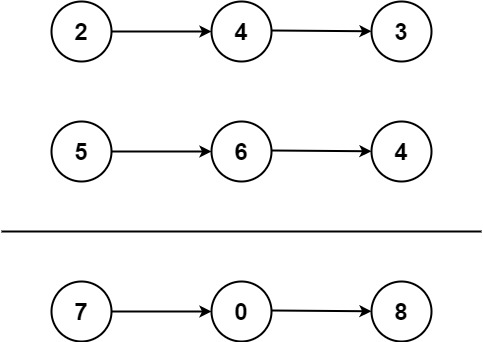
输入:l1 = [2,4,3], l2 = [5,6,4]
输出:[7,0,8]
解释:342 + 465 = 807.输入:l1 = [9,9,9,9,9,9,9], l2 = [9,9,9,9]
输出:[8,9,9,9,0,0,0,1]1️⃣ 迭代#
/**
 * Definition for singly-linked list.
 * struct ListNode {
 *     int val;
 *     ListNode *next;
 *     ListNode() : val(0), next(nullptr) {}
 *     ListNode(int x) : val(x), next(nullptr) {}
 *     ListNode(int x, ListNode *next) : val(x), next(next) {}
 * };
 */
class Solution {
public:
    ListNode* addTwoNumbers(ListNode* l1, ListNode* l2) {
        ListNode dummy;
        ListNode* cur = &dummy;
        int carry = 0;
        while (l1 || l2 || carry) {
            int res = 0;
            if (l1) {
                res += l1->val;
                l1 = l1->next;
            }
            if (l2) {
                res += l2->val;
                l2 = l2->next;
            }
            res += carry;
            carry = res / 10;
            cur = cur->next = new ListNode(res % 10);
        }
        return dummy.next;
    }
};2️⃣ 递归#
/**
 * Definition for singly-linked list.
 * struct ListNode {
 *     int val;
 *     ListNode *next;
 *     ListNode() : val(0), next(nullptr) {}
 *     ListNode(int x) : val(x), next(nullptr) {}
 *     ListNode(int x, ListNode *next) : val(x), next(next) {}
 * };
 */
class Solution {
public:
    ListNode* addTwoNumbers(ListNode* l1, ListNode* l2, int carry = 0) {
        if (!l1 && !l2) {
            return carry ? new ListNode(carry) : nullptr;
        }
        if (!l1) {
            swap(l1, l2);
        }
        int sum = carry + l1->val + (l2 ? l2->val : 0);
        l1->val = sum % 10;
        l1->next = addTwoNumbers(l1->next, (l2 ? l2->next : nullptr), sum / 10);
        return l1;
    }
};445. 两数相加 II ↗|链表版 · 从尾开始➕#
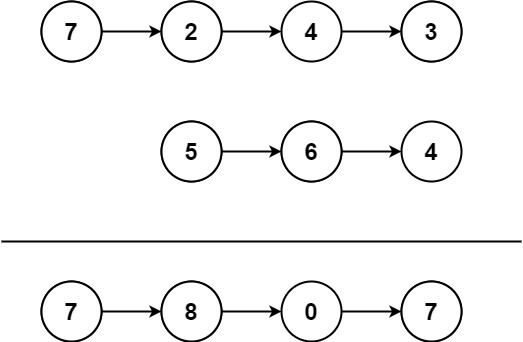
输入:l1 = [7,2,4,3], l2 = [5,6,4]
输出:[7,8,0,7]✅ 两数相加 II = 两数相加 + 反转链表
1️⃣ 迭代|206. 反转链表(迭代)+ 2. 两数相加(迭代)#
class Solution {
public:
    ListNode* reverseList(ListNode* head) {
        ListNode* pre = nullptr;
        ListNode* cur = head;
        while (cur) {
            ListNode* nxt = cur->next;
            cur->next = pre;
            pre = cur;
            cur = nxt;
        }
        return pre;
    }

    ListNode* addTwoNumbers(ListNode* l1, ListNode* l2) {
        l1 = reverseList(l1);
        l2 = reverseList(l2);
        ListNode dummy;
        ListNode* cur = &dummy;
        int carry = 0;
        while (l1 || l2 || carry) {
            int res = carry;
            if (l1) {
                res += l1->val;
                l1 = l1->next;
            }
            if (l2) {
                res += l2->val;
                l2 = l2->next;
            }
            carry = res / 10;
            cur = cur->next = new ListNode(res % 10);
        }
        return reverseList(dummy.next);
    }
};2️⃣ 递归|206. 反转链表(递归)+ 2. 两数相加(递归)#
class Solution {
public:
    ListNode* reverseList(ListNode* head) {
        if (!head || !head->next) {
            return head;
        }
        ListNode* new_head = reverseList(head->next);
        head->next->next = head;
        head->next = nullptr;
        return new_head;
    }

    ListNode* addTwo(ListNode* l1, ListNode* l2, int carry = 0) {
        if (!l1 && !l2) {
            return carry ? new ListNode(carry) : nullptr;
        }
        if (!l1) {
            swap(l1, l2);
        }
        int sum = carry + l1->val + (l2 ? l2->val : 0);
        l1->val = sum % 10;
        l1->next = addTwo(l1->next, (l2 ? l2->next : nullptr), sum / 10);
        return l1;
    }

    ListNode* addTwoNumbers(ListNode* l1, ListNode* l2) {
        l1 = reverseList(l1);
        l2 = reverseList(l2);
        ListNode* head = addTwo(l1, l2, 0);
        return reverseList(head);
    }
};67. 二进制求和 ↗|二进制版#
给你两个二进制字符串 a 和 b ,以二进制字符串的形式返回它们的和。
示例 1:
输入:a = "11", b = "1"
输出:"100"示例 2:
输入:a = "1010", b = "1011"
输出:"10101"class Solution {
public:
string addBinary(string a, string b) {
int carry = 0;
int i = a.length() - 1, j = b.length() - 1;
string ans;
while (i >= 0 || j >= 0 || carry) {
int x = i >= 0 ? a[i--] - '0' : 0;
int y = j >= 0 ? b[j--] - '0' : 0;
int s = x + y + carry;
carry = s / 2;
ans.push_back(s % 2 + '0');
}
reverse(ans.begin(), ans.end());
return ans;
}
};43. 字符串相乘 ↗|大数相乘✖️#
给定两个以字符串形式表示的非负整数 num1 和 num2,返回 num1 和 num2 的乘积,它们的乘积也表示为字符串形式。
**注意:**不能使用任何内置的 Big Integer 库或直接将输入转换为整数。
示例 1:
输入: num1 = "2", num2 = "3"
输出: "6"示例 2:
输入: num1 = "123", num2 = "456"
输出: "56088"1️⃣ 竖式相加#
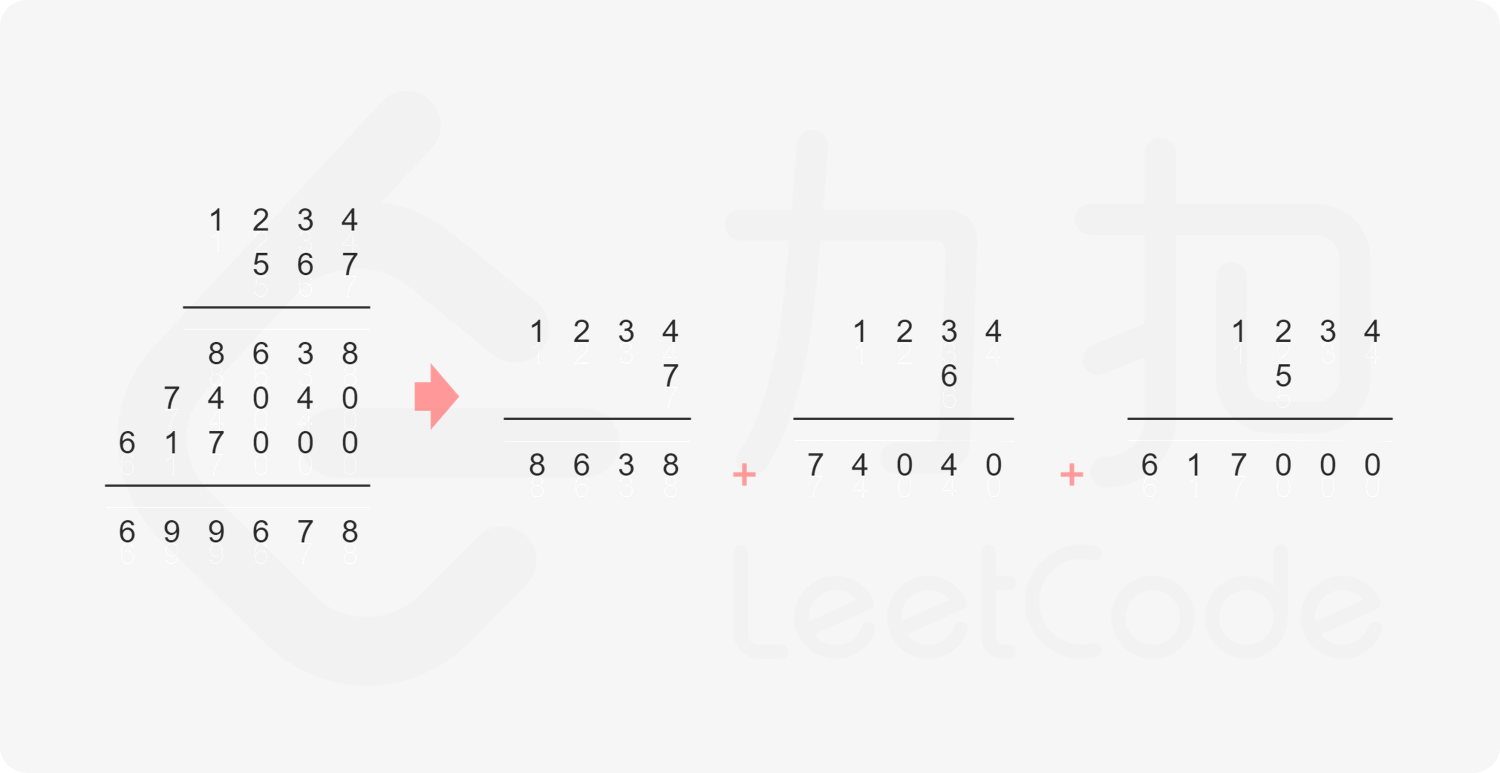
思路:建立在「大数相加」的基础上,因为多个数之间需要累加(容易理解)
class Solution {
public:
    // 大数相加
    string addStrings(string num1, string num2) {
        int i = num1.length() - 1, j = num2.length() - 1, add = 0;
        string ans = "";
        while (i >= 0 || j >= 0 || add) {
            int x = i >= 0 ? num1[i] - '0' : 0;
            int y = j >= 0 ? num2[j] - '0' : 0;
            int result = x + y + add;
            add = result / 10;
            ans.push_back('0' + result % 10);
            i--;
            j--;
        }
        reverse(ans.begin(), ans.end());
        return ans;
    }

    // 大数相乘
    string multiply(string num1, string num2) {
        if (num1 == "0" || num2 == "0")
            return "0";
        int multiply = 0;
        int m = num1.length(), n = num2.length();
        string ans = "0";
        for (int i = m - 1; i >= 0; i--) {
            int x = num1[i] - '0';
            string num;
            int add = 0;
            for (int j = n - 1; j >= 0 || add; j--) {
                if (x == 0) {
                    num = "0";
                    break;
                }
                if (j < 0) {
                    num.push_back('0' + add);
                    break;
                }
                int y = num2[j] - '0';
                int result = x * y + add;
                add = result / 10;
                num.push_back('0' + result % 10);
            }
            reverse(num.begin(), num.end());
            if (num != "0")
                ans = addStrings(ans, num + string(multiply, '0'));
            multiply++;
        }
        return ans;
    }
};2️⃣ 相乘#
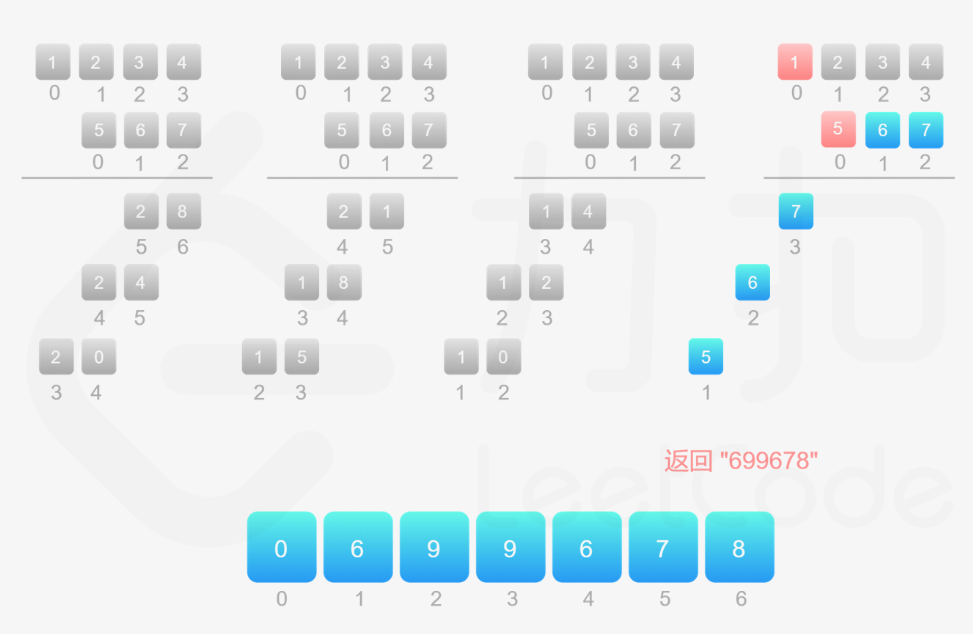
思路:直接做乘法,长度分别为 m 和 n 的数字相乘,值长度不超过 m + n,vector<int> ansArr(m + n)
class Solution {
public:
    string multiply(string num1, string num2) {
        if (num1 == "0" || num2 == "0") {
            return "0";
        }
        int m = num1.length(), n = num2.length();
        vector<int> ansArr(m + n);
        for (int i = m - 1; i >= 0; i--) {
            int x = num1[i] - '0';
            for (int j = n - 1; j >= 0; j--) {
                int y = num2[j] - '0';
                ansArr[i + j + 1] += x * y;
            }
        }
        for (int i = m + n - 1; i > 0; i--) {
            ansArr[i - 1] += ansArr[i] / 10;
            ansArr[i] %= 10;
        }
        int idx = ansArr[0] == 0 ? 1 : 0;
        string ans;
        while (idx < m + n) {
            ans.push_back('0' + ansArr[idx]);
            idx++;
        }
        return ans;
    }
};